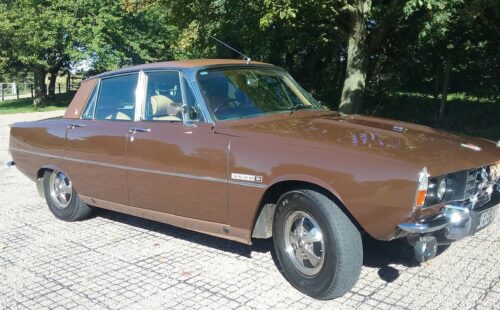
- 1949 Rover 75 P3 Saloon sold August 2023
- Check out our current auction listings HERE
- 2.1 litre straight-six engine
- Regency Maroon
- Black wings
- Original grey leather upholstery
- Many original features
| MAKE | Rover |
| MODEL | 75 P3 Saloon |
| REGISTRATION | FFW 958 |
| ENGINE SIZE | 2103 |
| TRANSMISSION | Manual |
| CURRENT V5 | |
| COLOUR | Red & Black |
| LOCATION | Northampton, Northants NN7 |
1949 Rover 75 P3 Saloon *Sold £9,000*
In stock
Description
- 1949 Rover 75 P3 Saloon sold August 2023
- Check out our current auction listings HERE
- 2.1 litre straight-six engine
- Regency Maroon
- Black wings
- Original grey leather upholstery
- Many original features
“One of Britain’s Finest Cars—Now Made Finer” is how the Rover brochure described the post-war classic Rover P3 75. They were right too. These Rovers were only made for two years. That makes them rather scarce today and, in this condition, very desirable.
History
- Original buff logbook from 1949
- MOTs dating back 40 years
Outside
The Rover P3 75 (the P standing for post-war) designed by Gordon Bashford was an entirely new Rover. It had the quality of Rover’s recent past, though the 75 was half an inch wider outside than the 16 it replaced, it was 2.5 inches wider inside. The Rover 75 could be bought in tall roof, “six-light” (three windows per side) Saloon, or Sports Saloon body styles.
All doors were rear hinged “coach doors” (or suicide doors). Remarkably for the time the Rover was produced in five colours— black, green, grey, maroon, and “Sundown” each with specific contrasting interior colours.
This Rover P3 75 is the so-called ‘Six-Light Saloon’. The Black and Red paintwork suits the big Rover. All the chrome is in good order, bear in mind that this car was built in 1949 though. It comes with lovely period features. Take a look around the car; those superb headlights, running boards, semaphores and those hubcaps – how have they survived. It is unusual to see one in this condition.
Inside
Jumping inside reminds you of a stately home that is growing old peacefully without the intervention of English Heritage making it ‘better’. It is all rather charming.
Features we just do not see on modern cars such as the armchair like armrests in the rear are all still there. Up front it is the same. The wood instrument panel and full instrumentation were part and parcel of the era. The original three thin spoke steering wheel remains. Ventilation improvements promised 100 cubic feet of air per minute. Or you could just open the huge windows, your choice.
It is a septuagenarian now so don’t be expecting a new car. But the great thing is it still looks original, well, as original as something can be after this length of time. Best of all it hasn’t been messed about with, therefore retains the old car feel.
Mechanicals
The whole of Britain faced enormous challenges in 1949. None more so than manufacturing industries. Rover took a bold step to innovate with the Rover P3.
The 1948-49 P3 Rover line was vastly simplified. The engines were the singular four and six-cylinder lines respectively dubbed 60 and 75 after approximating real horsepower ratings.
The engines were a clean-sheet post-war design, featuring several modern features:
- Inclined cylinder head
- Intake valves in the cylinder head
- Exhaust valves in the block itself
- A side mounted double-roller-chain-driven camshaft.
- This required crossflow intake and exhaust manifolds
- The upmarket six-cylinder engine like this one, used a two-barrel down-draught carburetor
- Light metal alloys were used in valve covers, timing covers, and the oil pan
This 2.1 litre straight-six makes 72 hp at 4,000 rpm. Rover designed a nearly hemispherical combustion chamber, with the spark plug located in the centre.
The engine is mated to a floor shifted four-speed manual with synchromesh on third and fourth gears, plus a freewheeling function to allow clutchless shifting on the move.
We’re told “This Rover drives just as she should with a strong engine and a quiet gearbox and is ready to be enjoyed by her new owner”.
This Rover P3 75 has other innovations that would be carried over into the modern-looking P4 75 of 1950.
- Independent coil spring front suspension with an anti-roll bar
- A semi-elliptical leaf spring rear
- The frame itself was all steel rather than the previous steel-over-ash construction Rover
- The rear leaf springs were attached directly to the body rather than the chassis.
- Hydraulic front brakes
All of this results in increased rear-axle travel and a smoother ride.
Summary
Autocar magazines tested a P3 on February 4, 1949:
“This satisfying car of the highest quality does everything with a silky smoothness, a soothing quietness, and also in about the highest degree of riding comfort in front and back seats yet known, and with a precision and lightness of control with makes a driver feel on top of his form and which renders every mile a delight whether in town or out on the open road…Throughout, there is that suggestion of top mechanical quality, exclusive to a tiny fraction of cars, which eludes detailed description.”
Praise indeed.
Related products
-
 Lot: 924
1991 Rover Montego LX
-
 Lot: 925
1996 Rover Mini Equinox
-
 Lot: 424
1947 Rover 12